

First published: 2025-11-15 / Last reviewed: 2026-05-28
This is a guide to Titanium lifting compiled by Dr. Choi Byeong-geun of SHINE U Clinic Konkuk (3 minutes walk from Konkuk Univ. Station Exit 1).
Some people hesitate when choosing a lifting procedure due to concerns about pain and volume loss in the cheeks. Titanium lifting uses a diode laser. Let's look at how it differs from dot-type HIFU and for whom it may be considered.

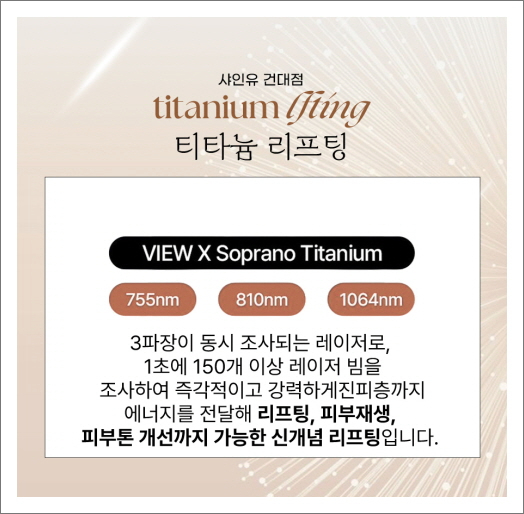
Three Wavelengths and Area Irradiation Method
Titanium uses three wavelengths (755nm, 810nm, 1064nm) simultaneously, reacting with water and protein in different tissues to induce uniform volume heating. In particular, 1064nm and 810nm reach depths of 6mm or more, providing thermal stimulation to the retaining ligaments and deep collagen tissue.
| Category | HIFU Dot Method | Titanium Area Method |
|---|---|---|
| Irradiation Type | Forms dot-shaped coagulation points | Irradiates broadly in an area shape |
| Heat Transfer | Concentrated at specific points | Gradually accumulates |
| Considerations | Risk of volume loss if focused on fat layer | Aims to reduce the risk of volume loss |
By irradiating the laser beam broadly over an area and slowly accumulating heat, it delivers even warmth and focuses on natural elasticity improvement.
In-Motion (SHR) Technology and Pain Management
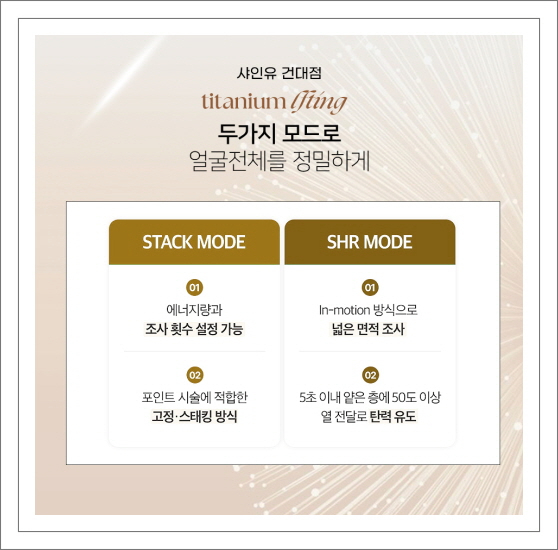
In-Motion technology rapidly moves the handpiece, repeatedly irradiating with low fluence to gradually accumulate heat. Unlike injecting high-intensity energy all at once, this method allows the skin to perceive heat slowly.
The powerful sapphire tip cooling system cools the epidermis, so the process may feel like a warm massage.
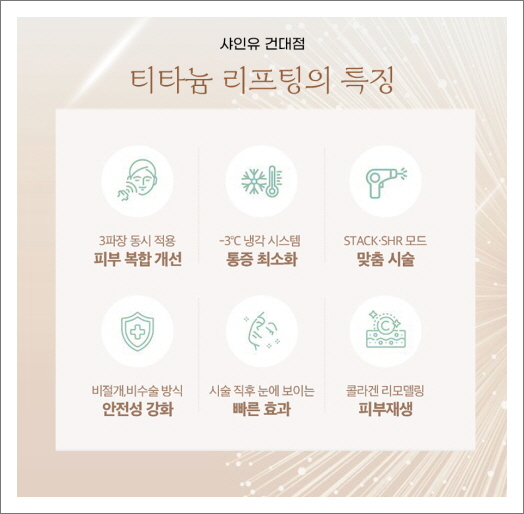
Utilizing a mode that irradiates approximately 150 laser beams per second, the entire face can be treated in about 10-15 minutes.
Retaining Ligament Strengthening and Tone Improvement
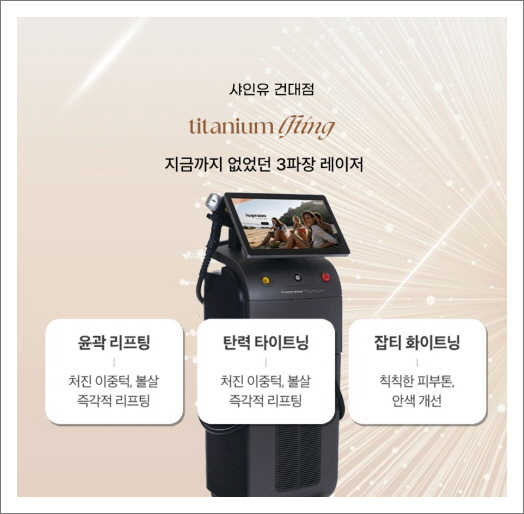
- STACK mode delivers heat to weakened retaining ligament layers to reinforce support.
- The 755nm wavelength acts on melanin, contributing to tone improvement.
- The 810nm wavelength helps reduce pores and improve skin texture.
Due to different depths of action, a layering strategy of treating the deep SMAS layer first, then supplementing dermal collagen with Titanium, is sometimes considered in conjunction with Ultherapy PRIME.
Consult to see if it suits your volume and elasticity condition
If You're Planning a Treatment
For a quick tightening sensation and long-term improvement through collagen regeneration, intensive care is usually recommended about 3 times at 3-4 week intervals. Afterward, maintenance care once every 6 months to 1 year can be considered. However, the number of sessions varies depending on skin condition.
If you're wondering if Titanium lifting is right for your concerns, please inquire via chat consultation. Suitability can be confirmed through a consultation with Dr. Choi Byeong-geun.

Authored by: Dr. Choi Byeong-geun (Chief Director of SHINE U Clinic Konkuk / Member of Korean Academy of Laser Dermatology and Hair, Korean Academy of Aesthetic and Plastic Surgery Laser Medicine, Korean Academy of Filler, etc.) Last reviewed: 2026-05-28
This article provides general information about procedures and does not replace diagnosis or treatment. The suitability and results of procedures may vary by individual.