

First published: 2025-12-13 / Last reviewed: 2026-05-28
This is a guide to Titanium lifting compiled by Dr. Choi Byeong-geun of SHINE U Clinic Konkuk (3 minutes walk from Konkuk Univ. Station Exit 1).
Even when receiving the same Titanium lifting, it is often necessary to approach different areas of the face differently. For example, fat under the chin may need to be reduced, while the cheeks may need to be protected from hollowing. Let's organize this from the perspective of how Titanium lifting is designed for each area in the consultation room.
The moving irradiation method enables design
Titanium lifting uses an in-motion method that continuously moves the handpiece to deliver energy. The face has many curves and slopes, such as the jawline, cheekbones, and temples. When the handpiece moves smoothly along the surface, energy reaches even narrow or curved areas without omission, which can reduce imbalance where the effect is concentrated on only one side.
Instead of applying instantaneous high heat to a single point, multiple low-energy pulses pass through, gradually raising the tissue temperature. The temperature is maintained for a certain period at a level suitable for collagen reaction, inducing tissue activation.
Because the handpiece is not fixed in one place and continues to move, some patients describe the sensation as warm and gentle rather than pain at a specific point. However, individual experiences may vary.
Why we divide the face into two areas in the consultation room
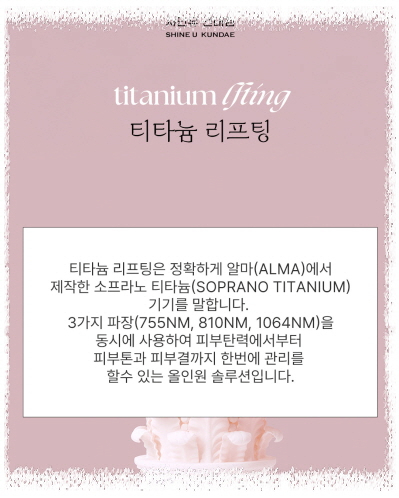
In the consultation room, we approach the face by dividing it into areas where fat needs to be reduced and areas where volume needs to be preserved.
- Areas for fat reduction: For areas where volume disrupts the line, such as a double chin, jowls, or a bulky jawline, the 1064nm ratio is increased and the number of passes is increased to concentrate more heat on the fat layer.
- Areas for volume preservation: For areas prone to hollowing, such as around the eyes, forehead, and under the cheekbones, 810nm collagen regeneration is emphasized and the 1064nm ratio is reduced to prevent fat loss.
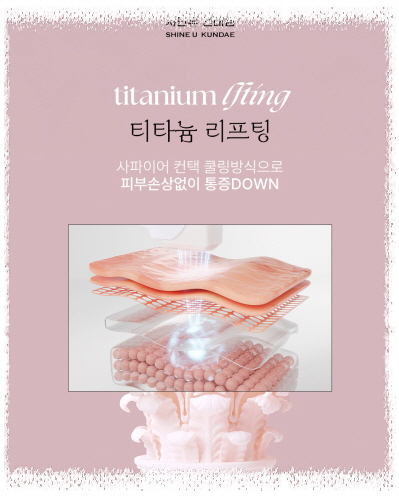
Even with the same device, the intensity and number of passes are applied differently for each area; for example, more passes for the jawline and fewer for the center of the cheek. The ability to adjust in this way is an advantage when designing the face with Titanium lifting.
"I want to receive the exact same settings as someone else." This is a request we sometimes receive. Since fat distribution, cheek hollowing, and the degree of aging vary from person to person, the same settings are not suitable for everyone. Designing differently for each area leads to more natural results, and individual results may vary.
The decision on how to divide and treat your face into different areas is made during a consultation with Dr. Choi Byeong-geun. If you have any questions, please leave a chat consultation for specific areas.
Increasing completeness with combination treatments
The gentle method of Titanium lifting is advantageous for designing treatments in combination with other procedures. This method involves first addressing the structural tightening of the SMAS layer with a HIFU device like Ultherapy PRIME, and then enhancing completeness by filling the broad dermal and fat layers with energy using Titanium lifting.

Facial design ultimately comes down to which areas to reduce and which areas to preserve. If you are curious about the combination that is right for you, please feel free to inquire via chat consultation.
Authored by: Dr. Choi Byeong-geun (Chief Director of SHINE U Clinic Konkuk / Member of the Korean Academy of Laser Dermatology and Hair, Korean Academy of Aesthetic Plastic Surgery and Laser Medicine, Korean Academy of Filler, etc.) Last reviewed: 2026-05-28
This article provides general information about procedures and does not replace diagnosis or treatment. The suitability and results of procedures may vary depending on the individual.