
First published: 2026-05-17 / Last reviewed: 2026-05-17
This is a guide to the Tune series by area, compiled by Dr. Choi Byeong-geun of SHINE U Clinic Konkuk (3 minutes walk from Konkuk Univ. Station Exit 1).
When we receive the question "Should I get TuneFace?" in the consultation room, we ask again. This is because Tune has three modes in one device, and depending on which area you are concerned about in front of the mirror, the same device can be used for completely different procedures. TuneFace works for overall facial texture and elasticity, TuneLiner for jawline and side profile, and TuneEye for the eye area, each performing its own role.
1. Why the Tune series is bundled into one device
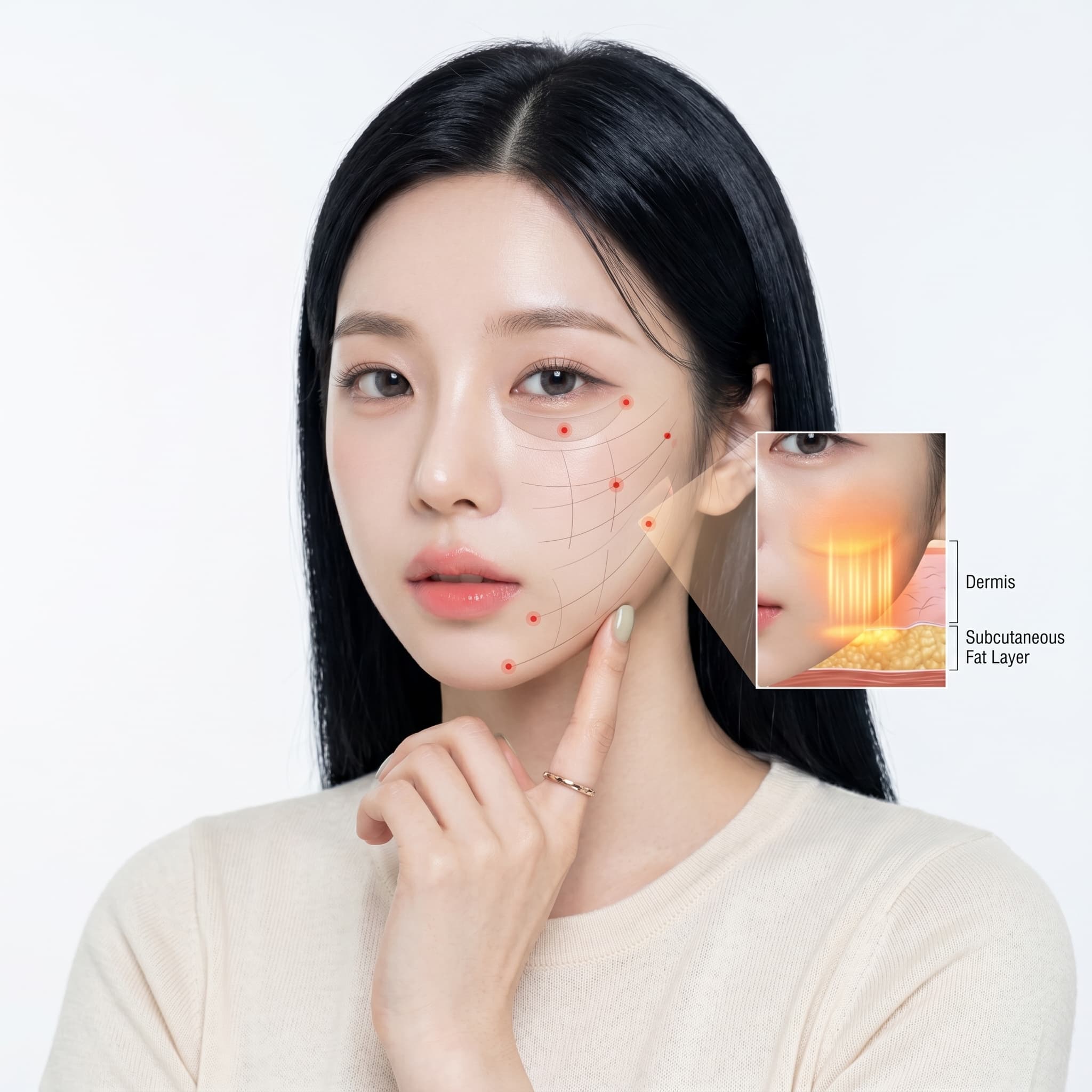
The Tune device is an RF (radiofrequency) platform with 30, 40, and 60kJ energy lineups. The design intent is to implement both Ultherapy's HIFU deep stimulation and Thermage's RF area heating in one device, and the output mode and tips are changed according to the characteristics of the area.
The common features of the three modes are as follows:
- Monopolar RF based — dermal collagen heating and rearrangement
- Immediate return to daily life, almost no recovery downtime
- Immediate elasticity recovery right after the procedure + gradual improvement through the collagen regeneration cycle (2-3 months)
The differences lie in the target area, tips used, and output distribution method.
2. TuneFace — Overall facial texture and elasticity
TuneFace is a mode that refines the overall facial texture, pores, and dullness at once. There are two intensity options, blue/red, and it is divided into steps of 30, 40, and 60kJ.
The patient profiles for whom TuneFace first comes to mind in the examination room are as follows:
- Those whose most noticeable change in the mirror is texture and dullness
- Those who are more concerned about makeup caking and pores than sagging
- Those who want to receive Ultherapy and Thermage at once
- Those who have an important event like a wedding coming up in a few days and are concerned about downtime
Since it heats the entire dermis in an area unit, changes in texture are relatively quick, and reports of improved makeup adherence right after the procedure are frequently received.
3. TuneLiner — Precise lifting in line units
TuneLiner is a mode that concentrates RF in line units, not area units. It is performed by drawing lines along the jawline, side profile, and V-zone with a thin tip.
TuneLiner is more suitable for the following profiles:
- Those whose jawline collapse is more noticeable when viewed from the side than from the front
- Those whose double chin and side profile boundaries have become blurred
- Those whose line below the cheekbones has sagged, creating shadows
- Those who want to receive it as a combo with InMode Fix rather than alone (combo option available)
Although it outputs from the same device, because it concentrates on line units, the contour emphasizing effect is more distinct than TuneFace.
When receiving TuneFace, "changes seen up close in the mirror" appear first, and when receiving TuneLiner, "changes seen in a side profile photo" appear first. If you ask yourself which change you are more concerned about, the choice becomes simpler.
4. TuneEye (TunePeriOrbital) — Eye area exclusive
TuneEye is a mode exclusively for the eye area. The skin around the eyes is thin and the orbital structure is close, so general RF can be too strong. TuneEye re-designs and applies the output and depth to suit the eye area.
The profiles for whom TuneEye is recommended in the examination room are:
- Those whose upper eyelids are sagging, causing makeup to smudge
- Those with distinct fine lines on the lower eyelids and under the eyes
- Those whose eyebrow line has sagged, making their impression look dull
- Those who have received Eye Thermage FLX but want to refine it one step further in terms of texture
Since the eye area is a very delicate area for procedure intensity and frequency distribution, the intensity is determined after directly checking the orbital structure and skin thickness in the examination room before the actual procedure.
Consult about the eye area via chat now
5. At-a-glance comparison by mode
| Item | TuneFace | TuneLiner | TuneEye |
|---|---|---|---|
| Target Area | Overall facial texture and elasticity | Jawline, side profile | Eye area, eyebrow line |
| Output Type | Area-unit RF | Line-unit RF | Area-specific RF |
| Strengths | Texture recovery, pore and dullness refinement | Line emphasis, contour tightening | Fine line and sagging eye area recovery |
| Pain | Warm sensation | Line stimulation | Mild stimulation |
| Recommended Cycle | Once every 6 months to 1 year | Once every 6 months to 1 year | Once every 3-6 months |
| Recovery | Immediate return to daily life | Immediate return to daily life | Immediate return to daily life |
| Combo Options | InMode, Eye Thermage | InMode Fix combo available | Thermage FLX for eyes |
All three modes are based on monopolar RF, so the collagen regeneration cycle works similarly. The difference is where and how energy is distributed.
6. Common confusions often brought up in the examination room
"Isn't one TuneFace enough for everything?" — This is the most frequent question. Many people who are concerned about both overall facial texture and contour are satisfied with TuneFace alone. However, if side profile lines are the primary concern, TuneLiner may create a more distinct change within the same procedure time, and if only the eye area is a concern, TuneEye may be more effective.
Another frequent question is, "If I get Tune, do I not need Ultherapy or Thermage?" Tune implements both RF area units and line units in one device, but Ultherapy's HIFU point-unit SMAS stimulation is separate. In cases of severe sagging, combining Ultherapy can create a deeper result. Which combination is right for you is determined by looking in the mirror in the examination room.
7. When receiving as an InMode combo
TuneLiner is often performed in combination with InMode Fix. When InMode's bipolar RF + vacuum suction is layered over line-unit RF, contour definition and skin texture refinement can be completed within the same procedure time.
A combo is not always better. Recommending a line procedure to someone who is only concerned about texture can easily lead to an excessive procedure. The decision to combine is made after confirming where the patient first sees changes in the mirror.
8. Post-procedure care
The following points are the same for all three modes:
- On the evening of the procedure, wash gently and do not rub.
- Temporary swelling, warmth, and redness will gradually improve.
- Avoid makeup on the day of the procedure if possible; you can resume as usual from the next day.
- Be diligent with moisturizing and using sunscreen.
- Avoid alcohol, smoking, saunas, and strenuous exercise for one week.
For the eye area (TuneEye), sunscreen is especially recommended. Pigmentation around the eyes affects the stability of the results.
9. Frequently Asked Questions
Q. If I'm getting it for the first time, which mode should I start with? It is based on which area you are most concerned about. If it's texture and dullness, start with TuneFace; if it's the side profile, TuneLiner; if it's the eye area, TuneEye. It is natural to add other modes after changes in one area have stabilized.
Q. When will the effects be most noticeable? Some changes are reported immediately after the procedure. The most distinct effects are seen at the 2-3 month mark when the collagen regeneration cycle is active. Gradual refinement continues up to 6 months.
Q. Can I receive it with other lifting procedures? It is often performed in the examination room in combination with Ultherapy PRIME, Thermage FLX, and Titanium lifting. However, it is not recommended to overlap two procedures on the same area on the same day, and it is more stable to use one tool at a time with a 2-4 week interval.
The reason the Tune series is in one device is that each patient has different areas of concern. If you take a moment to identify what you see first in the mirror, it will naturally narrow down which mode to start with. If you find it difficult to decide, you can inquire directly via non-face-to-face consultation via chat.
Authored by: Dr. Choi Byeong-geun (Chief Director of SHINE U Clinic Konkuk / Member of the Korean Academy of Laser Dermatology and Hair, Korean Academy of Aesthetic and Plastic Surgery Lasers, etc.) Last Reviewed: 2026-05-17
This article provides general information about procedures and does not replace diagnosis or treatment. Suitability for procedures and results may vary by individual.