

First published: 2025-12-12 / Last reviewed: 2026-05-28
This is a guide to Ultherapy PRIME compiled by Dr. Choi Byeong-geun of SHINE U Clinic Konkuk (3 minutes walk from Konkuk Univ. Station Exit 1).
As the number of HIFU lifting devices increases, we often receive the question, "So, how is Ultherapy different from others?" Ultherapy is a device often cited as the standard for HIFU lifting that targets the SMAS layer. Let's organize the differences from other devices from a comparative perspective.

The difference lies in whether you can see inside the skin during treatment
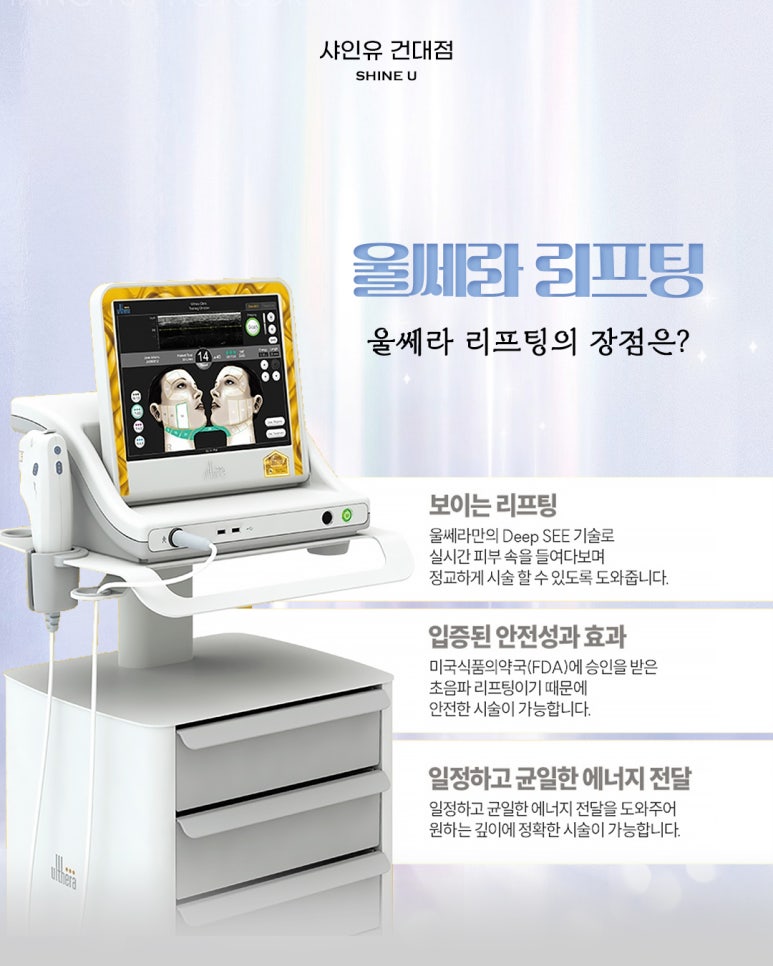
The biggest feature that distinguishes Ultherapy from other HIFU devices is that the practitioner can directly see inside the skin during the procedure. The Ultherapy handpiece has a built-in ultrasound transducer, which allows the practitioner to monitor the location and thickness of the dermis, fat layer, and SMAS layer in real-time on a monitor while delivering energy.
| Item | HIFU without imaging | Ultherapy |
|---|---|---|
| Depth confirmation | Relies on experience | Real-time confirmation with imaging |
| Avoiding dangerous structures | Difficult | Avoids while viewing nerves and blood vessels |
| Target accuracy | Possible variations | Forms uniform coagulation points |
Since the skin thickness and SMAS layer depth vary from person to person, setting the precise target depth while viewing it is related to the safety and effectiveness of the procedure.

Mechanism of action on the SMAS layer
The SMAS layer, which is the core support for sagging, is located between the fat layer and the muscle layer. Ultherapy forms thermal coagulation points in this layer, causing the tissue to contract instantaneously. This contraction is the principle that creates the immediate tightening effect after the procedure.
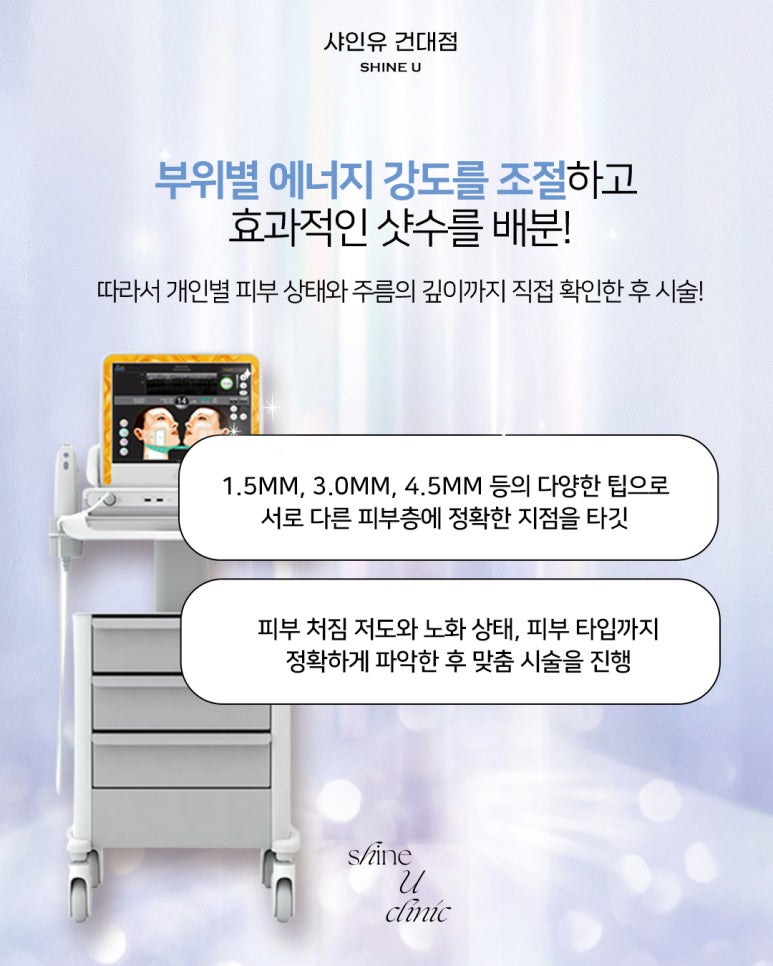
The wound healing response around the coagulation points activates fibroblasts to produce new collagen and elastin, and density and elasticity gradually increase over approximately 2-3 months after the procedure. This collagen production is the mechanism that maintains the effect for a long time.
"So, is Ultherapy all I need?" This is a frequently asked question. Ultherapy is a device that excels in deep SMAS layer tightening, but it is not a single solution for all skin concerns. For other concerns such as dermal texture or tone, other devices may be more suitable, so the combination varies depending on the condition.
Cartridge division by depth
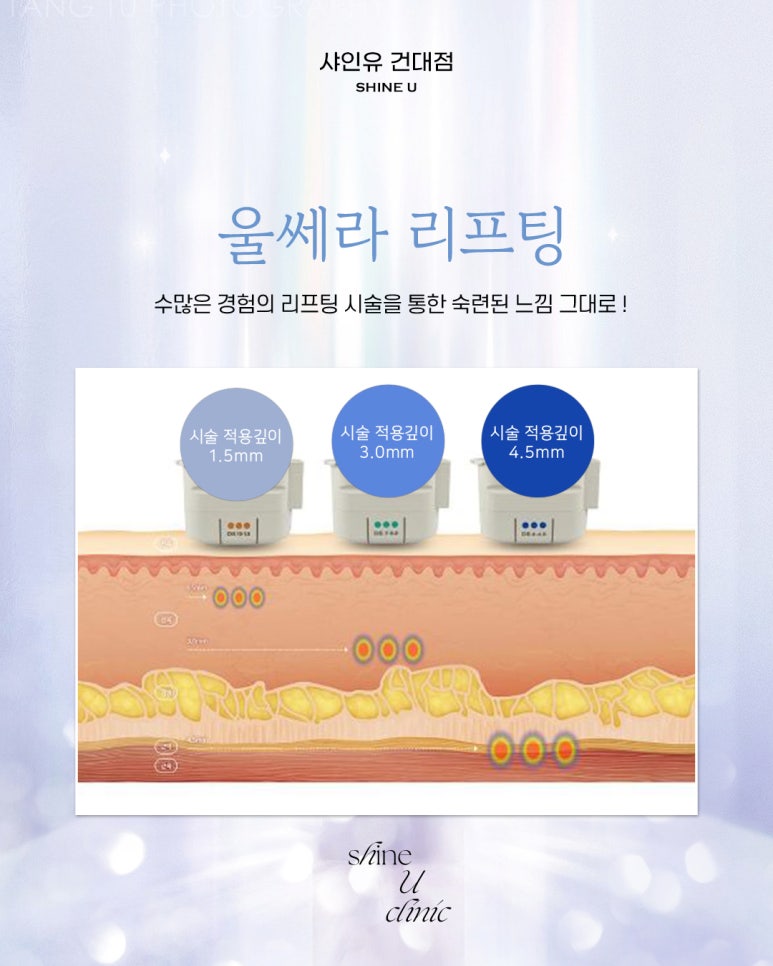
Ultherapy uses three different cartridges for different depths.
- 4.5mm: Targets the SMAS layer to improve sagging, mainly used for jawline and cheek sagging.
- 3.0mm: Acts on the deep dermis and fibrous fat tissue to promote collagen regeneration and enhance elasticity.
- 1.5mm: Acts on the superficial dermis to improve fine wrinkles and skin texture.
Commonly used areas

Ultherapy is often used for areas that require structural improvement of the entire face. It works by lifting sagging jawlines and loose tissue under the chin to refine the contour, and non-surgically lifting sagging cheeks and eyebrow lines. Whether Ultherapy is suitable for your degree of sagging, or how it should be combined with other devices, is something to confirm during Dr. Choi Byeong-geun's consultation. If you have any questions, please leave a chat consultation.
If you are also concerned about dermal texture and tone, Thermage FLX may be designed in combination. If you are curious about the right combination for you, please feel free to inquire via chat consultation.
Authored by: Dr. Choi Byeong-geun (Chief Director of SHINE U Clinic Konkuk / Member of the Korean Academy of Laser Dermatology and Hair, Korean Academy of Aesthetic and Plastic Surgery, Korean Academy of Filler, etc.) Last reviewed: 2026-05-28
This article provides general information about procedures and does not replace diagnosis or treatment. The suitability and results of the procedure may vary depending on the individual.